Words Shakespeare Invented: Everyday Words and Phrases We Still Use Today
You may not realise it, but William Shakespeare has probably already appeared in your conversations today.
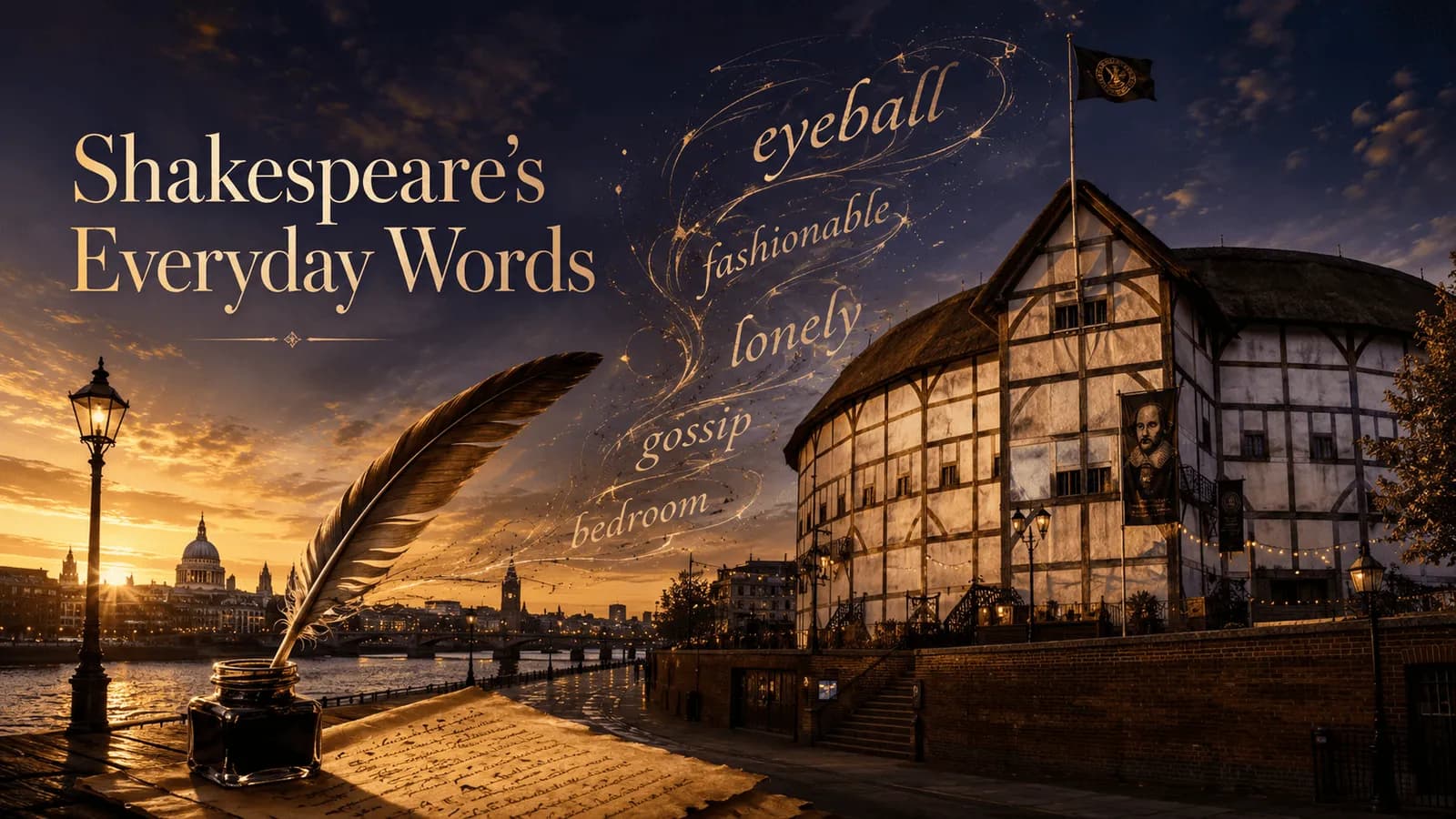
If you have called something “fashionable”, complained about feeling “lonely”, looked someone in the “eyeball”, gone “downstairs”, had a “gossip”, spoken to a “manager”, or said you did not sleep “one wink”, you have been brushing up against the language of Shakespeare.
Not bad for a playwright who was working more than 400 years ago.
And here in Southwark, that connection feels especially close. Walk along Bankside today and Shakespeare’s Globe still stands as one of London’s most recognisable cultural landmarks, keeping alive the spirit of the theatre that helped change English forever.
The original Globe opened in Southwark in 1599, at a time when the south bank of the Thames was full of energy, entertainment and noise. This was not a quiet literary salon. It was London at full volume. Audiences laughed, shouted, cheered, jeered, bought food, met friends and packed themselves into playhouses to watch stories unfold.
In the middle of all that bustle, Shakespeare was not just writing plays. He was helping shape the way we speak.
“All the world’s a stage”
Shakespeare’s words have travelled far beyond the stage.
Many of the phrases we use today began life in his plays, or at least were first written down there. His work gave us expressions that still feel fresh, funny, dramatic and useful.
When someone says there is “too much of a good thing”, they are echoing As You Like It.
When something makes “neither rhyme nor reason”, that comes from The Comedy of Errors.
If you have “not slept one wink”, Shakespeare used that in Cymbeline.
If someone says “it’s Greek to me”, that phrase appears in Julius Caesar.
If you describe jealousy as a “green-eyed monster”, you are stepping into the world of Othello.
And if you warn that “something wicked this way comes”, you are bringing a little bit of Macbeth into the room.
These phrases survive because they work. They are short, vivid and memorable. They turn ordinary feelings into pictures. They make speech more colourful.
That was Shakespeare’s gift. He could take a feeling everyone understood and give it a shape people would remember for centuries.
“What’s in a word?”
The big question, of course, is this: did Shakespeare really invent all these words?
The honest answer is: sometimes, probably. Other times, maybe not.
Shakespeare is often credited with inventing or introducing more than 1,700 words into the English language. But that does not always mean he sat down with a quill and created each word from nothing. In many cases, his plays and poems give us the first written record of a word being used.
Some words may already have been spoken in streets, taverns, homes, markets or backstage before Shakespeare put them into print. Others may have been adapted by him from existing words, by adding prefixes, suffixes or new endings.
That is still extraordinary.
Whether he invented a word, recorded it, popularised it or made it unforgettable, Shakespeare helped it survive.
In a time before social media, newspapers as we know them, radio, television or the internet, his plays were one of the great engines of popular culture. A clever line could move from the stage into the street. A new phrase could be repeated by audiences. A striking word could stick.
Southwark was part of that journey.
“The play’s the thing”
It is easy to think of Shakespeare as high culture now, something studied in classrooms or performed in grand theatres. But in his own time, theatre was public entertainment.
The Globe was a place where people from different parts of society could gather. There were groundlings standing in the yard, wealthier audience members in the galleries, actors moving through stories of love, murder, power, jealousy, comedy and madness.
The language had to work for everyone.
That is why so many Shakespearean words are still so direct. They sound fancy when placed beside velvet curtains and candlelit stages, but many of them are wonderfully practical.
Bedroom is simple and useful.
Eyeball is almost cartoonishly clear.
Downstairs does exactly what it says.
Lonely captures a feeling we still struggle with.
Fashionable remains essential in any city with shops, style and opinions.
Manager has followed us into offices, shops, theatres, football clubs and group chats.
These are not dusty museum pieces. They are working words. They clock in every day.
“It’s Greek to me”
Part of the fun of Shakespeare’s language is how familiar it feels once you start noticing it.
We often think we are being modern when we use phrases like “break the ice”, “wild-goose chase”, “heart of gold”, “good riddance” or “seen better days”. Yet these expressions are all strongly associated with Shakespeare’s writing.
They have lasted because they do what great phrases always do: they make complicated things simple.
A “wild-goose chase” instantly tells us someone has been sent on a pointless or chaotic search.
“Seen better days” gently says something is worn out, tired or past its best.
“Good riddance” gives us two sharp words for a feeling of relief.
“Break the ice” turns social awkwardness into a physical image everyone understands.
That is why Shakespeare still belongs in everyday life. His language is dramatic, but it is also incredibly efficient.
“Too much of a good thing”
There is a reason Shakespeare’s words are so useful for writers, journalists, teachers, performers and anyone who loves language.
He understood contrast.
He could be funny and tragic in the same breath. He could write for kings and fools. He could make a scene feel huge and public, then suddenly intimate and private. His vocabulary stretched across love, politics, insults, ghosts, storms, murder, mistaken identity and complete chaos.
That range gave English more room to move.
Some words credited to Shakespeare feel emotional, such as lonely, gloomy and majestic.
Some feel physical, such as eyeball, elbow and downstairs.
Some feel social, such as gossip, critic and manager.
Some feel wonderfully dramatic, such as swagger, assassination and bedazzled.
Even when scholars debate whether Shakespeare truly created every one, the larger point remains: his work preserved and popularised a huge amount of language. He gave words a stage, and the audience helped carry them away.
“Something wicked this way comes”
One of the reasons people still search for “words Shakespeare invented” is that the idea feels almost magical.
A person writes a line for a play in the late 1500s or early 1600s, and centuries later someone in Southwark, Sunderland, Edinburgh, New York or Sydney uses part of it without even noticing.
That is a strange kind of immortality.
Most writers hope to be read. Shakespeare is not only read. He is spoken by people who do not even know they are quoting him.
He is there when someone says they are “in a pickle”.
He is there when a meeting has “come full circle”.
He is there when someone says “love is blind”.
He is there when a tired friend says they have “seen better days”.
He is there when someone tries to “break the ice”.
The words have become so natural that they no longer feel borrowed. They feel like ours.
“To thine own self be true”
For Southwark, Shakespeare is not just a national literary figure. He is part of local history.
Bankside was one of the places where English theatre found its voice. The Globe was not simply a building; it was a meeting place between story and audience, between spoken language and public life.
That matters because language is not created in silence. It grows through use. It changes when people repeat it, laugh at it, misunderstand it, reshape it and pass it on.
Shakespeare’s Southwark was noisy, crowded and alive. That is exactly the kind of place where words can catch fire.
Today, visitors still come to Bankside to experience Shakespeare’s Globe, while schoolchildren, theatre lovers, tourists and Londoners continue to connect with the plays. The setting has changed, but the power of the words remains.
“The rest is silence”
Except, of course, it is not.
Shakespeare’s words are anything but silent.
They are still in our homes, our workplaces, our schools, our arguments, our jokes and our headlines. They are in the way we describe love, boredom, ambition, jealousy, confusion, tiredness and joy.
That may be the most remarkable thing about his influence. Shakespeare does not only belong to the past. He is hiding in plain sight in the present.
So the next time you call something fashionable, complain that you are lonely, tell someone they are on a wild-goose chase, say you have not slept one wink, or admit that something is Greek to you, remember this:
You may be speaking a little Shakespeare.
And in Southwark, with the Globe still standing on Bankside, that history feels wonderfully close to home.
