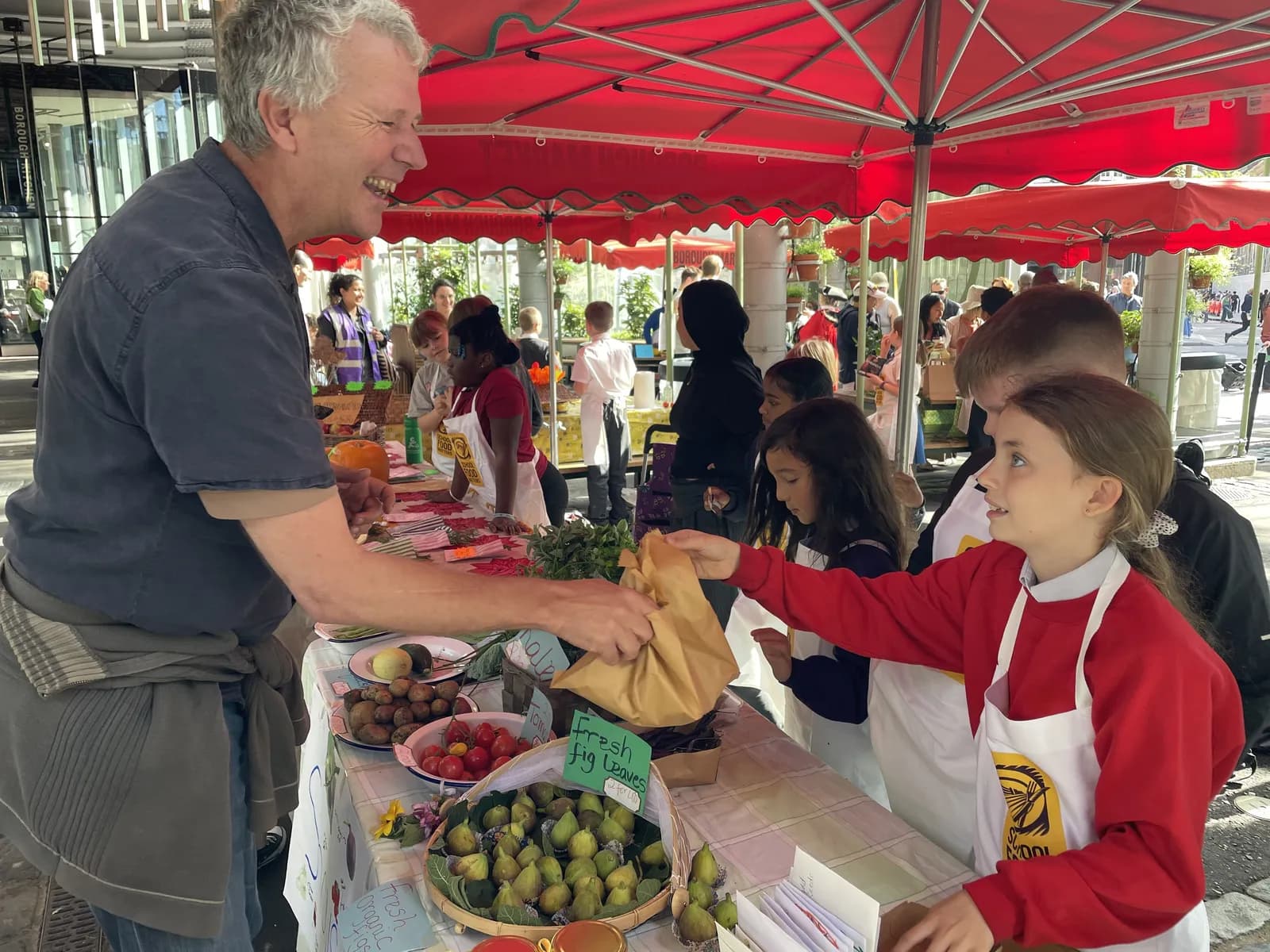
Borough Market has stood on the southern approach to London Bridge for nearly a millennium. Throughout that time it has weathered plague, fire, aerial bombardment, railway expansion, and the threat of closure, emerging each time as a vital food source for Southwark and beyond.
From Saxon Trading Post to Chartered Market
The market's origins stretch back to at least 1014, when the Icelandic historian Snorri Sturluson described Southwark as a "great market town" in his saga of King Olaf. Its first documented mention came in 1276, when a market was recorded adjacent to the southern end of London Bridge.
By 1215, two distinct marketplaces had emerged. St Thomas' Hospital operated a corn market trading on Wednesdays, Fridays, and Saturdays, whilst a larger general market occupied Borough High Street on Wednesdays and Fridays. The area's position at the southern end of London Bridge, first constructed around 990 AD, made it a natural gathering point for traders selling to travellers entering the city.
In 1550, Edward VI sold Southwark to the City of London for just over £1,000, and a charter extended trading to four days per week. A further charter from Charles II in 1671 fixed the market limits from the southern end of London Bridge to St Margaret's Hill near present-day Guy's Hospital.
Fire and Plague: The 17th Century Test
The market faced its first major existential threat on 26 May 1676, when a fire swept along Borough High Street and burned for 17 hours. King Charles II and the Duke of York personally oversaw firefighting efforts. The flames destroyed the market house, the administrative centre where grain was kept dry, forcing traders to rebuild.
The market had already endured the Great Plague of 1665, which killed an estimated 100,000 Londoners over 18 months. Although specific records of the market's operation during this period are sparse, it would have remained essential for food distribution even as trading likely operated at reduced capacity.
The Railway Arrives: Opportunity and Disruption
The 19th century brought the most dramatic physical transformation. In 1851, the market buildings were redesigned by Henry Rose. A decade later, in 1862, the South Eastern Railway Company constructed a viaduct through the middle of the market to extend lines from London Bridge to Cannon Street and Charing Cross. The railway brought noise, soot, and disruption, but also improved accessibility for traders and customers.
The market adapted by trading beneath the viaduct arches. When railway companies sought to expand further, a compromise was reached: the market granted only a "flying leasehold" for the permanent way, meaning the railway could operate but the market retained ownership. This arrangement persists today, with trustees receiving compensation for each expansion.
The Victorian era marked the market's commercial peak. By 1933, an estimated 1,750,000 bushels of fruit and vegetables were sold at Borough annually. The 1930s saw 188 covered pitching stands let to 81 wholesale companies, with a further 203 stands in the uncovered periphery.
War Years: Trading Under Fire
The market's resilience was tested again during both World Wars. When World War I began, most of the market's 20 porters enlisted. By the end of 1915, 12 had shipped to the front and two more had left for munitions factories, leaving only porters in their 50s and 60s to manage the workload. Superintendent Thomas Haynes wrote to authorities in desperation, stating that "the irreducible minimum has been reached." In November 1917, a German air raid caused substantial damage to the superintendent's offices and market roof. The market nonetheless "struggled on, year after year, bringing vital supplies to a much-stretched nation."
World War II brought even greater peril. Southwark was the most heavily bombed of London's inner boroughs during the Blitz, with 1,651 high-explosive bombs and 20 parachute mines falling in just eight months. On 29 September 1940, four market trustees, including three members of the Cheeseman family, were killed whilst acting as air-raid wardens on Great Guildford Street. A fifth trustee had died weeks earlier at Ewer Street shelter. A bomb fell on Green Dragon Court, causing significant roof damage; shrapnel marks from this explosion are still visible on Southwark Cathedral.
On 22 January 1945, a V2 missile struck Borough High Street near the Southwark Street junction, destroying or damaging around 200 buildings and killing dozens at the Mosers ironmongery workshop. Throughout these attacks, the market continued to function as a vital link in the city's food supply chain, with traders operating under strict blackout restrictions in what was described as "eerie, difficult darkness."
Reinvention and Revival
The post-war decades brought new challenges. The growth of supermarkets in the 1980s and 1990s put the market's future in doubt. Salvation came in November 1998, when a Food Lovers' Fair opened by the television presenters "Two Fat Ladies" proved a roaring success. The trustees decided to hold regular retail markets, initially monthly, then weekly.
This reinvention transformed Borough from a wholesale hub into a retail destination for high-quality food. The market now opens six days per week, and in 2021 began opening on Sundays for the first time in its recent history. Major refurbishment began in 2001, and in 2004 the Grade II-listed South Portico from Covent Garden's Floral Hall was re-erected at the market after being dismantled during the Royal Opera House reconstruction.
The Modern Market and Its Southwark Roots
Today, Borough Market occupies a 4.5-acre site and consists of three main areas: Three Crown Square for larger producers, the Green Market for specialist traders, and the Borough Market Kitchen for street food. The market remains a charitable trust administered by volunteer trustees who must live in the vicinity, run for the benefit of the community.
The market has not been without controversy. In 2011, seven traders were expelled for trading at nearby Maltby Street Market, having criticised Borough's facilities and its move toward takeaway food sales. The market also faced disruption following the London Bridge terror attack in June 2017, which killed eight people in the area; it closed for 11 days before reopening.
Most recently, the Thameslink Programme has necessitated alterations to listed buildings in the market area, including the demolition of Smirke Terrace in 2010. Each such change requires negotiation with trustees under the flying leasehold arrangement.